Factors Affecting 12 kg cng cylinder price and Storage Standards
Procuring high-pressure gas storage requires a delicate balance between volumetric efficiency and operational safety. For enterprises integrating clean energy into their logistics or industrial processes, understanding the technical variables that influence the 12 kg cng cylinder price is essential for long-term cost-benefit analysis. These specialized pressure vessels are not merely containers but engineered systems designed to withstand extreme stresses while maintaining gas purity and structural integrity.
CIMC Enric provides advanced storage solutions that bridge the gap between high-capacity transport and site-specific distribution. By focusing on high-pressure performance and international certification standards, the company ensures that every unit delivered optimizes the energy density of compressed natural gas (CNG) and hydrogen, reducing the overall footprint of gas infrastructure in demanding industrial environments.

Engineering Standards for High-Pressure Gas Storage Vessels
The reliability of a CNG cylinder depends heavily on the materials used and the manufacturing precision of the vessel wall. In the field of gas compression and separation equipment, the primary challenge is managing the hoop stress exerted by gases stored at high pressures. CIMC Enric utilizes high-strength alloys and advanced welding techniques to ensure that cylinders can maintain a consistent working pressure of 20 MPa without compromising safety.
Beyond material strength, thermal stability is a critical factor. These cylinders are engineered to operate across a wide temperature spectrum, typically from -40°C to 60°C. This ensures that the equipment remains functional in both arctic conditions and high-heat industrial zones, preventing material fatigue or embrittlement that could lead to catastrophic failure. The integration of ASME and DOT certifications further validates the structural integrity of these vessels for global deployment.
- Pressure Rating: Optimized for 20 MPa working pressure to maximize gas density.
- Thermal Range: Broad operational capability from -40°C to 60°C.
- Certification: Compliant with internationally recognized ASME and DOT standards.

Optimizing Energy Density Through Modular Cylinder Configurations
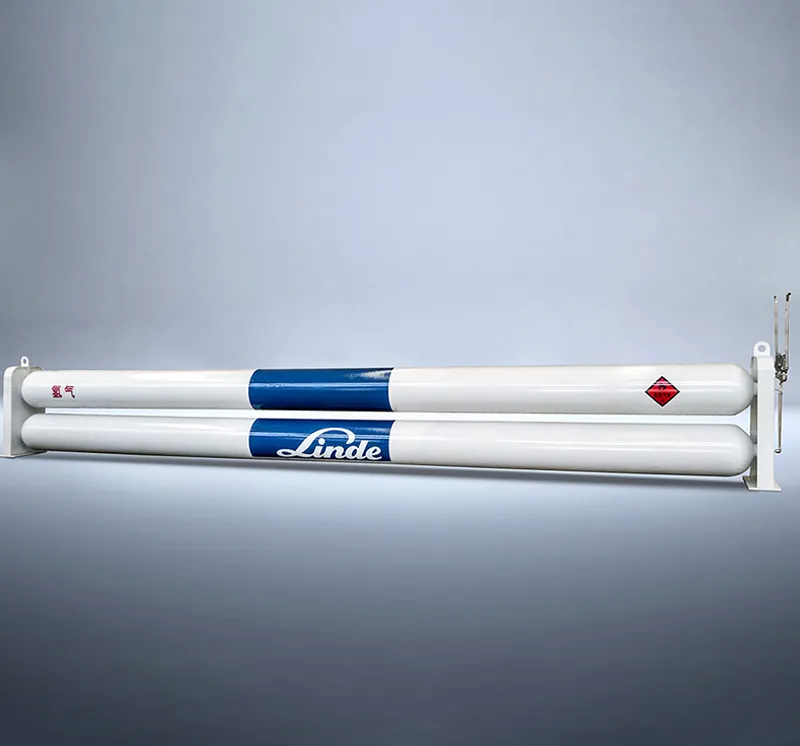
For large-scale energy distribution, individual cylinders are often integrated into modular racks or cascades. The ability to scale the number of cylinders—ranging from 8 to 12 units—allows operators to customize the total gas capacity based on the specific needs of the transport vehicle or the storage station. This modularity is key to reducing the cost per kilogram of stored gas while maintaining flexibility in logistics.
The physical size of the storage frame, typically available in 10ft, 20ft, 30ft, or 40ft configurations, dictates the total throughput of the system. By aligning the cylinder quantity with the frame size, CIMC Enric maximizes the spatial efficiency of the transport unit. This engineering approach is particularly beneficial for hydrogen (H2) and CNG applications where the volume-to-weight ratio is a primary concern for transportation efficiency.
Critical Application Scenarios in Clean Energy Logistics
High-pressure cylinders are the backbone of the "virtual pipeline" concept, where gas is transported via tube trailers instead of permanent underground pipes. This is essential for serving remote industrial sites, fueling stations, and semiconductor facilities that require ultra-high purity gases. In these scenarios, the ability to rapidly swap cylinder racks ensures a continuous supply of energy without interrupting production cycles.
Furthermore, the transition toward hydrogen-powered maritime and terrestrial transport has increased the demand for vessels that can handle the unique permeability of hydrogen. CIMC Enric's experience in developing the world's first hydrogen-powered ship demonstrates the capacity to handle the most stringent leakage and pressure requirements, making their equipment suitable for the most advanced electronic gas and specialty gas industries.
Technical Specification and Application Matrix
| Technical Parameter | Standard Range | Operational Impact | Suitability |
|---|---|---|---|
| Working Pressure | 20 MPa | Determines gas storage density | High-pressure CNG/H2 |
| Temperature Range | -40 to 60 °C | Ensures structural stability | Extreme Climates |
| Frame Size | 10ft - 40ft | Influences transport capacity | Modular Logistics |
| Cylinder Quantity | 8 - 12 Units | Controls total gas volume | Customized Volume |
| Medium Type | CNG / H2 | Requires specific alloy lining | Clean Energy |
Evaluating Supplier Capabilities for Pressure Vessel Procurement
When evaluating the total cost of ownership, buyers must look beyond the initial 12 kg cng cylinder price and consider the manufacturer's certification pedigree. A supplier with ASME and DOT certifications provides a guarantee that the product has undergone rigorous fatigue testing and quality audits. This reduces the risk of operational downtime and ensures compliance with local safety regulations in markets like the US, Europe, and South Korea.
Manufacturing consistency is another critical metric. A high-tech enterprise capable of producing both standard industrial cylinders and ultra-high purity equipment for the semiconductor industry indicates a sophisticated quality control system. CIMC Enric's long-term partnerships with global leaders like Linde and Air Liquide serve as a benchmark for the reliability and scalability of their production lines.
Future Trends in High-Pressure Gas Storage Technology
The industry is moving toward lighter, stronger materials to further increase the gas-to-weight ratio. The adoption of composite materials and advanced liner technologies is expected to lower the energy required for transportation while increasing the safety margins of the vessels. This evolution is driven by the global shift toward lower-carbon energy solutions and the need for more efficient hydrogen distribution networks.
Digital integration is also becoming a standard. The inclusion of smart sensors for real-time pressure and temperature monitoring allows for predictive maintenance, reducing the likelihood of unplanned outages. As the energy equipment industry evolves, the focus will shift from simple storage to integrated energy management systems that optimize the entire supply chain from compression to end-use.
Common Technical Inquiries Regarding CNG Storage
What factors most significantly influence the cost of high-pressure CNG cylinders?
The primary drivers are the material grade (such as high-strength alloy steel), the required working pressure (e.g., 20 MPa), and the international certifications (ASME, DOT) required for the specific target market.
Can these cylinders be used for gases other than CNG?
Yes, depending on the lining and material specifications, they can be used for hydrogen (H2) and other industrial or specialty gases. However, hydrogen requires specific permeability considerations.
How does the temperature range affect the safety of the cylinder?
Extreme cold can lead to material embrittlement, while extreme heat can increase internal pressure. Our cylinders are rated for -40°C to 60°C to prevent these risks.
What is the advantage of using a modular cylinder rack over a single large tank?
Modular racks allow for easier maintenance, scalable capacity (from 8 to 12 cylinders), and greater flexibility in transportation using standard shipping frame sizes.
Which certifications should I look for when importing gas equipment?
For global standards, ASME (American Society of Mechanical Engineers) and DOT (Department of Transportation) are the most critical for ensuring safety and legal compliance.
How is the working pressure of 20 MPa determined?
This pressure is a standard balance between maximizing the amount of gas stored per volume and maintaining a safe operating margin for transport and discharge.
Technical References and Industry Standards
- ASME Boiler and Pressure Vessel Code (BPVC)
- U.S. DOT Pipeline and Hazardous Materials Safety Administration
- ISO Standards for Gas Cylinders
- International Energy Agency - Hydrogen Report
Selecting the right high-pressure storage equipment is a critical decision that impacts both the operational efficiency and the safety profile of your energy infrastructure. By partnering with an experienced manufacturer like CIMC Enric, you ensure that your equipment meets global standards and is optimized for your specific industrial application.
Related Energy Storage Solutions