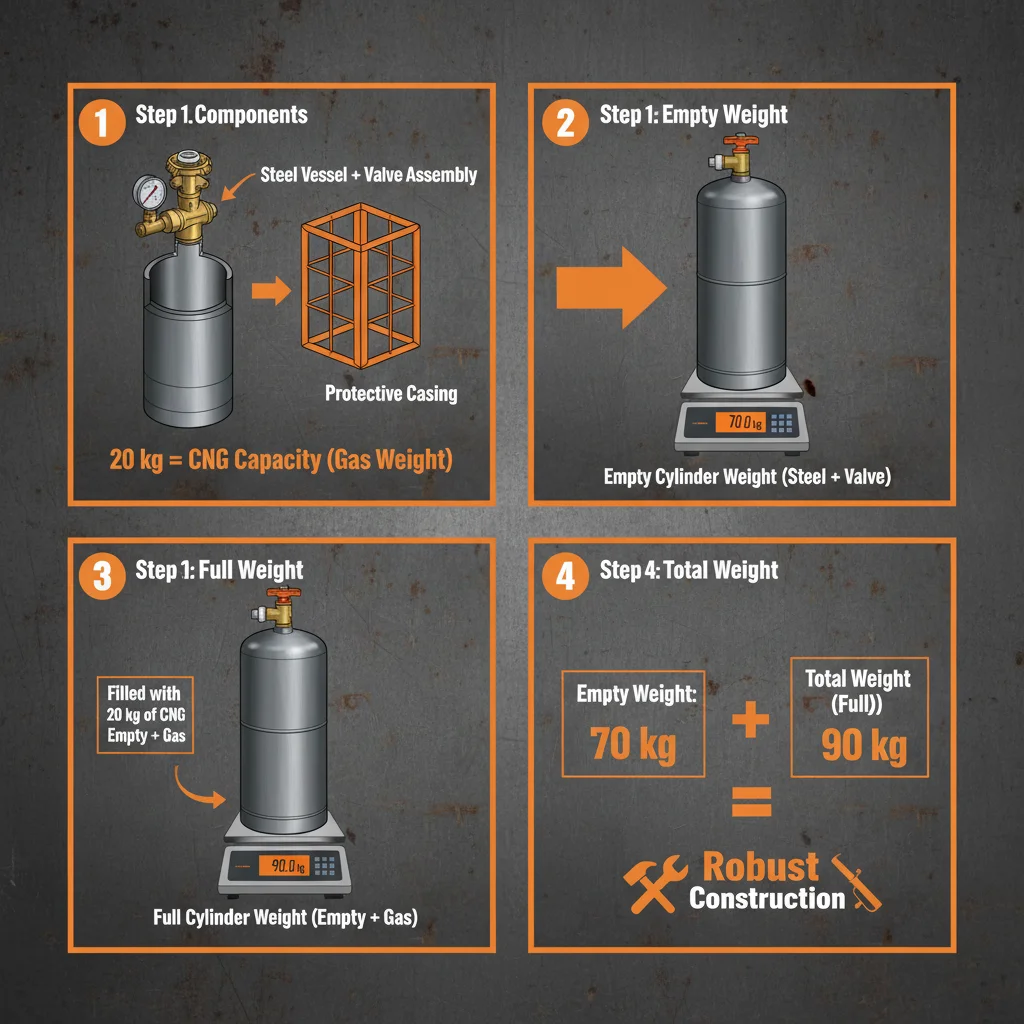
Selecting a storage solution for compressed natural gas often leads buyers to a specific cross-section of capacity and cost, specifically when researching the cng cylinder price 12 kg. While the capacity is a primary driver, the actual value of these cylinders is dictated by material science, pressure ratings, and the certification standards they meet.
The market for small-to-medium CNG cylinders is currently shifting toward lightweight composite materials to improve fuel efficiency in transport and reduce handling costs in industrial settings. This evolution means that a simple price comparison often overlooks the long-term operational savings associated with lower tare weights and extended service life.
To make an informed procurement decision, it is essential to look beyond the initial quote and analyze the technical specifications that influence durability and safety. This guide examines the variables affecting pricing and the technical benchmarks used to evaluate high-pressure gas storage.


The demand for cylinders in the 12 kg range is largely driven by the "last-mile" distribution of natural gas in regions lacking pipeline infrastructure. These units serve as flexible energy carriers, allowing for the transport of fuel to remote industrial sites or specialized vehicle fleets.
Consequently, the pricing is not merely a reflection of the steel or carbon fiber used, but also of the logistical demand for modularity. As industries pivot toward green energy, the requirement for standardized, portable storage units has increased, placing a premium on certified, high-throughput cylinders.
Pricing for CNG storage is primarily split between Type 1 (seamless steel) and Type 3 or 4 (composite/plastic liners). Steel cylinders are more affordable upfront but possess a significant weight penalty, which increases transport costs and reduces the efficiency of the gas-to-weight ratio.
Composite cylinders utilize a high-strength carbon fiber wrap around a liner. This drastically reduces the tare weight, allowing for more fuel to be carried per unit of vehicle weight. However, the sophisticated winding process and the cost of carbon fiber significantly elevate the initial capital expenditure compared to steel options.
When evaluating the cng cylinder price 12 kg, buyers must calculate the Total Cost of Ownership (TCO). A more expensive composite cylinder often pays for itself through reduced fuel consumption in transport and a longer fatigue life under repeated filling cycles.
The safety profile of a CNG cylinder is determined by its working pressure (WP) and test pressure (TP). For a 12 kg capacity, the cylinder must withstand immense internal stress, making international certifications such as DOT or ASME non-negotiable for industrial deployment.
True value in high-pressure storage is found in the margin between the operating pressure and the burst pressure; a higher safety factor reduces the risk of catastrophic failure during thermal expansion or mechanical impact.
Certification processes involve rigorous hydrostatic testing and cycle testing. A cylinder produced by an entity with extensive certification history—such as those adhering to global maritime and land transport standards—offers a lower risk profile, which justifies a price premium over non-certified alternatives.
Beyond the initial purchase price, the operational efficiency of a cylinder is measured by its weight-to-capacity ratio. In a typical industrial setting, transporting 1,000 cylinders of 12 kg capacity reveals a stark difference in logistics costs between steel and composite materials.
The following index illustrates the relative value based on weight reduction and durability, where a higher value indicates a more favorable long-term economic return despite a higher initial cost.
Small-scale cylinders are rarely used in isolation; they are part of a broader ecosystem involving compression stations and dispensing units. The compatibility of the valve system and the threading of the cylinder are critical for ensuring leak-free operations.
A manufacturer that provides end-to-end solutions—integrating the storage cylinder with the compression and treatment technology—can optimize the filling process. For example, using advanced Natural Gas Liquefaction (LNG) and Treatment solutions to ensure the feed gas is ultra-pure before compression extends the internal life of the cylinders by preventing corrosion.
The industry is currently witnessing a convergence between CNG and hydrogen storage technologies. Hydrogen molecules are significantly smaller than methane, leading to a phenomenon known as hydrogen embrittlement in traditional steel cylinders.
This technical challenge is driving the adoption of Type 4 cylinders, which use non-metallic liners that are impervious to hydrogen. As enterprises expand their "Green Energy" portfolios, investing in cylinders that can be transitioned or adapted for hydrogen service provides a future-proof hedge against energy transitions.
The transition involves not only material changes but also a recalibration of pressure limits, as hydrogen requires much higher pressures (up to 700 bar) to achieve viable energy densities compared to CNG.
When determining the best cng cylinder price 12 kg for a specific project, procurement officers should use a weighted matrix that balances initial cost, weight, and certification.
A low-cost cylinder that lacks a comprehensive certification history may seem attractive, but the potential for operational downtime or regulatory fines makes it a high-risk choice. Conversely, over-specifying the material (e.g., using Type 4 where Type 1 suffices) can lead to unnecessary capital waste.
The table below provides a relative suitability framework based on common industrial deployment scenarios.
| Scenario | Preferred Material | Primary Driver | Relative Suitability |
|---|---|---|---|
| Fixed Site Storage | Type 1 Steel | Upfront Cost | High |
| Vehicle Integration | Type 4 Composite | Weight/Efficiency | High |
| Remote Field Transport | Type 3 Aluminum | Durability | Medium |
| Hydrogen Transition | Type 4 Composite | Permeability | High |
| Low-Frequency Use | Type 2 Hooped | Balance | Medium |
| Extreme Environments | High-Grade Alloy | Thermal Stability | Medium |
The primary variations stem from material choice—specifically the difference between seamless steel and carbon fiber composites. Additionally, the pressure rating (e.g., 200 bar vs 250 bar) and the level of international certification (ASME, DOT, ISO) significantly impact the cost. Higher certifications require more rigorous testing and documentation, which adds to the final price.
Weight directly affects the "payload efficiency." In transport, every kilogram of cylinder weight (tare weight) is a kilogram of potential fuel or cargo lost. Composite cylinders, while more expensive, reduce the total vehicle weight, leading to lower fuel consumption for the transport vehicle and reduced wear on vehicle suspension and braking systems over time.
Generally, no for steel cylinders due to hydrogen embrittlement, which makes the metal brittle and prone to cracking. However, Type 4 composite cylinders with plastic liners are often designed with hydrogen compatibility in mind. It is critical to check the manufacturer's specifications and the pressure rating, as hydrogen usually requires significantly higher pressures than CNG.
Steel cylinders are highly durable but prone to internal and external corrosion if not properly coated. Composite cylinders generally have a defined service life (often 15-20 years) based on the fatigue of the resin and fiber. However, because they do not corrode, they often maintain their integrity better in humid or salty environments than untreated steel.
Authentic cylinders should have a permanent stamp or label indicating the manufacturer, the date of production, the working pressure, and the certifying body (such as DOT or ASME). Procurement teams should request the Mill Test Report (MTR) and the certificate of conformity from the supplier to ensure the unit meets the required international safety standards.
Yes. Impurities such as water vapor, H2S, and CO2 can cause internal corrosion in steel liners. Utilizing an integrated pretreatment system that removes moisture and acids to ppm levels ensures that the gas stream is "clean," thereby protecting the cylinder walls and preventing premature failure or leakage.
Evaluating the cng cylinder price 12 kg requires a shift from a "price-per-unit" mindset to a "value-per-cycle" analysis. The intersection of material science and safety certification determines not only the initial cost but the overall viability of a natural gas distribution strategy.
As the global energy landscape transitions toward cleaner fuels, the ability to deploy safe, lightweight, and certified storage solutions will be a key competitive advantage for industrial operators. Investing in high-quality equipment today ensures operational safety and readiness for the hydrogen-driven future.